Red light therapy devices are often described using one or two familiar numbers: 660 nm for visible red light and 850 nm for near-infrared light. Modern multi-wavelength systems can offer a much broader spectrum. But what does adding more wavelengths actually change, and does every wavelength have the same level of scientific support?

Celsium’s advanced light therapy system combines nine wavelengths:

  • 480 nm;
  • 590 nm;
  • 630 nm;
  • 660 nm;
  • 670 nm;
  • 810 nm;
  • 830 nm;
  • 850 nm;
  • 1060 nm.


Together, these span visible blue, amber and red light as well as invisible near-infrared light. The purpose of a multi-wavelength panel is not to claim nine guaranteed benefits. It is to give the user control over different parts of the light spectrum and the flexibility to select or combine wavelengths according to the device instructions and intended routine.

This distinction matters. Photobiomodulation is shaped not only by wavelength but also by irradiance, treatment time, distance, total energy delivered, pulse settings, target tissue and individual response. Two sessions using the same wavelength can produce very different doses.

This guide explains the nine wavelengths used by Celsium, the differences between visible and near-infrared light, what current research can and cannot tell us, and how to approach a configurable panel responsibly. For a broader introduction, begin with our guide to red light therapy benefits.

What Is Multi-Wavelength Light Therapy?

Light is electromagnetic energy organised by wavelength. Wavelength is measured in nanometres, abbreviated as nm, and determines where light sits within the visible or infrared spectrum.

Human eyes perceive only a limited part of that spectrum. Blue, amber and red wavelengths are visible. Near-infrared light is outside the visible range, so the light-emitting diodes may appear dim or inactive even when they are delivering energy.

In a multi-wavelength panel, different LED channels emit different spectral bands. A configurable system may allow those channels to be used individually or in combinations. This creates more flexibility than a basic two-wavelength device, but it also requires more informed use.

Multi-wavelength does not mean that all nine wavelengths must be active during every session. It also does not mean that every wavelength reaches the same depth or has been studied for the same purpose. The strongest protocol is the one that matches the wavelength, intensity and duration to a clearly defined goal while staying within the manufacturer’s safety guidance.

How Photobiomodulation Works

Photobiomodulation, often shortened to PBM, describes biological responses triggered by non-ionising light at controlled doses. Red and near-infrared light are the ranges most commonly associated with PBM research.

At the cellular level, researchers have investigated several interacting mechanisms, including:

  • absorption of light by cellular chromophores;
  • changes in mitochondrial signalling;
  • temporary modulation of reactive oxygen species;
  • nitric oxide-related signalling;
  • changes in local circulation and inflammatory pathways;
  • downstream effects on tissue repair and cellular activity.


These mechanisms should not be reduced to the marketing phrase “charging the cells.” Light does not simply add unlimited energy to mitochondria. Biological responses are complex, tissue-specific and dose-dependent.

PBM commonly demonstrates a biphasic dose response: too little energy may produce no meaningful response, while excessive exposure may reduce or reverse the desired effect. More power, more wavelengths and longer sessions are therefore not automatically better.

The Four Spectral Groups in the Celsium System

The nine wavelengths can be understood in four groups.

Blue light: 480 nm

The 480 nm channel sits in the visible blue region. Blue light is different from conventional red and near-infrared PBM because it is absorbed more superficially and interacts with different biological targets.

Blue-light research has investigated antimicrobial and dermatological applications, particularly acne. However, many acne studies use wavelengths closer to approximately 405–420 nm, sometimes combined with red light. Evidence from those devices should not be automatically transferred to an exact 480 nm protocol.

For Celsium users, 480 nm should be regarded as a specialised visible-light option rather than a general deep-recovery wavelength. The exact dose, treatment area and eye-safety requirements are particularly important.

Amber light: 590 nm

The 590 nm channel appears amber or yellow-orange. It sits between shorter visible wavelengths and the more widely studied red PBM range.

Research into 590 nm light has explored skin redness, pigmentation and cellular responses in skin models. Some studies are promising, but the evidence base is smaller than for common red and near-infrared wavelengths. Laboratory findings should not be presented as guaranteed cosmetic outcomes in humans.

In a multi-wavelength system, 590 nm broadens the visible spectrum and may be included in skin-focused protocols where supported by the device instructions. It should not be described as interchangeable with 630 or 660 nm red light.

Red light: 630, 660 and 670 nm

The 630–670 nm channels occupy the visible red range. These wavelengths are widely used in PBM research and are commonly selected for skin-facing and relatively superficial targets.

Red light penetrates more deeply than blue light but generally less deeply than near-infrared wavelengths. Research has examined its relationship with skin appearance, collagen density, wound-related processes, inflammation and recovery. Results depend heavily on the treatment parameters and study population.

The presence of three nearby red wavelengths does not mean each has a completely separate biological purpose. Their absorption profiles overlap. Providing 630, 660 and 670 nm offers spectral flexibility and allows the system to reproduce or approximate a wider variety of research protocols.

Near-infrared light: 810, 830, 850 and 1060 nm

The 810–1060 nm channels are invisible near-infrared wavelengths. NIR light is generally selected when the goal is to deliver light beyond the most superficial layers of skin.

Research has explored NIR PBM for muscle recovery, exercise performance, pain-related applications and neurological research. Penetration is not unlimited, and the amount of light reaching a target declines as it is scattered and absorbed by skin, fat, blood and other tissues.

The 1060 nm channel sits beyond the commonly marketed 810–850 nm range. Research using wavelengths around 1064 nm has investigated specialised applications, including transcranial PBM, but results from clinical laser systems cannot be assumed to apply directly to a full-body LED panel. Device type, irradiance, beam profile, treatment site and dose are different.

What Does 480 nm Light Do?

At 480 nm, light is visible blue and relatively superficial. It is strongly absorbed by pigments and does not penetrate tissue in the same way as red or near-infrared light.

Blue-light studies have often focused on acne because certain wavelengths can interact with porphyrins produced by acne-associated bacteria. This interaction may generate reactive molecules that contribute to an antimicrobial effect. Clinical research has evaluated blue-light devices and blue-plus-red combinations for mild to moderate inflammatory acne.

However, three limitations are essential:

  • Many published acne protocols use blue light closer to 415 nm rather than exactly 480 nm.
  • Results from a purpose-built dermatology device do not establish the correct settings for every consumer panel.
  • Blue light is not the preferred channel for deep tissue or muscle-focused sessions.

The responsible description of 480 nm is therefore: a visible, surface-oriented wavelength that expands the panel’s skin-focused capabilities, with exact outcomes dependent on protocol and clinical context.

Because blue light is bright and potentially uncomfortable to view, follow the eye-protection instructions supplied with the panel.

What Does 590 nm Light Do?

At 590 nm, the light appears amber. It is often discussed in relation to skin tone, redness and photoageing, but its evidence base is still developing.

Laboratory work has investigated how 590 nm exposure affects human dermal fibroblasts. Other research has explored erythema and pigmentation-related pathways. These findings provide scientific interest, not proof that any home session will produce a particular cosmetic result.

In practical terms, 590 nm can be viewed as a bridge between blue and red channels. It allows a configurable panel to offer a broader visible-light profile and to support more tailored skin routines.

Marketing claims such as “590 nm removes pigmentation” or “590 nm rebuilds collagen” would be too strong. A more accurate statement is that 590 nm has been studied for skin-related biological responses, while the optimal consumer protocol and magnitude of benefit remain less established than for some red-light applications.

What Does 630 nm Red Light Do?

The 630 nm wavelength is a common visible-red option in dermatology and PBM research. It can reach into skin more effectively than blue light and has been studied in skin rejuvenation, recovery and wound-related contexts.

When used at an appropriate dose, red light may influence cellular signalling associated with tissue repair and inflammation. Controlled research using red and near-infrared systems has reported improvements in measures such as skin roughness and collagen density, although these studies often use combinations of wavelengths rather than isolating 630 nm.

For a configurable panel, 630 nm is well suited to visible-red programmes where the treatment target is relatively superficial. It can also be combined with nearby red or NIR channels when the device protocol calls for broader coverage.

What Does 660 nm Red Light Do?

The 660 nm channel is one of the most recognisable wavelengths in consumer red light therapy. It is visible, widely used and positioned near a region where several cellular chromophores may respond to light.

Research has used wavelengths around 660 nm in skin, wound, oral-health and muscle-related protocols. The exact outcome varies with dose, delivery method and tissue. A panel emitting 660 nm is not equivalent to every 660 nm laser or small clinical LED device.

Within the Celsium system, 660 nm provides a well-established red-light anchor. It can be used alone where supported by the manual or combined with NIR channels to create a surface-plus-deeper-light session.

What Does 670 nm Red Light Do?

The 670 nm channel sits at the longer-wavelength end of visible red light. It overlaps strongly with 660 nm in practical PBM use but extends the red spectrum slightly closer to near-infrared.

Research at 670 nm has included retinal and visual applications, among other fields. Those applications often use precisely controlled, low-dose specialist devices. They should not be recreated by directing a general-purpose panel at the eyes.

In a full-body or skin-facing panel, 670 nm provides additional flexibility within the red band. The presence of 630, 660 and 670 nm lets users select between nearby research-relevant wavelengths without implying that each channel produces an entirely different outcome.

What Does 810 nm Near-Infrared Light Do?

At 810 nm, the light is invisible NIR. This wavelength is commonly studied for muscle, neurological and recovery-related PBM because it can penetrate more deeply than visible red light under comparable conditions.

Human exercise studies have investigated 810 nm PBM before activity, with some reporting effects on performance or recovery and others finding limited or inconsistent results. This variation reinforces the importance of dose.

For body-focused routines, 810 nm may be selected when the intended target lies below the most superficial skin layers. It should still be used according to the panel’s specified distance and session time.

What Does 830 nm Near-Infrared Light Do?

The 830 nm channel is another established NIR wavelength. It has been used in studies involving musculoskeletal conditions, recovery and tissue healing.

The difference between 810 and 830 nm is not a simple switch from one benefit to another. Their penetration and absorption characteristics overlap. Having both channels increases the system’s ability to match different research protocols and to distribute energy across a wider NIR band.

Users should avoid assigning rigid labels such as “810 nm for energy” and “830 nm for joints.” Biological effects depend on the complete protocol, not the wavelength number alone.

What Does 850 nm Near-Infrared Light Do?

The 850 nm wavelength is widely used in consumer PBM panels and is often paired with 660 nm red light. It is invisible, relatively efficient to produce with LEDs and commonly selected for body-focused exposure.

Studies using wavelengths in the broader 800–900 nm region have investigated muscle performance, post-exercise recovery, pain and inflammatory pathways. Results are not uniform, and systematic evaluations note substantial differences between protocols.

For the Celsium system, 850 nm serves as a familiar NIR channel that can complement visible red light. It should not be marketed as a guaranteed treatment for pain or injury, and the panel is not a replacement for clinical assessment.

What Does 1060 nm Near-Infrared Light Do?

The 1060 nm channel is the longest wavelength in the Celsium spectrum. Its optical behaviour differs from 810–850 nm because tissue absorption changes as wavelengths increase.

Research around 1064 nm has examined specialised transcranial PBM and other laser-based applications. These studies are scientifically relevant but highly device-specific. A 1064 nm clinical laser directed at a defined area cannot be treated as equivalent to a 1060 nm LED panel used at a different distance and irradiance.

The correct claim is that 1060 nm expands the available NIR spectrum and offers an additional channel for advanced, manufacturer-defined protocols. It should not be promoted with unqualified promises about brain function, fat reduction or neurological treatment.

Why Combine Multiple Wavelengths?

A multi-wavelength panel can provide three practical advantages.

Broader spectral coverage

Different wavelengths are absorbed and scattered differently. Combining visible red and NIR channels can deliver energy across a broader range of superficial and deeper tissue layers.

Greater protocol flexibility

Scientific studies use many different wavelengths. A configurable device can more closely approximate a broader selection of spectral protocols than a fixed 660/850 nm panel.

Personalised sessions

If the system allows each wavelength to be adjusted independently, users can select channels and intensity rather than accepting a single fixed spectrum.

These advantages relate to flexibility, not guaranteed superiority. A simple, well-characterised two-wavelength device used with an appropriate dose may be more effective than a nine-wavelength panel used without a clear protocol.

Why Dose Matters More Than the Number of Wavelengths

Wavelength tells you what colour or spectral band the light occupies. It does not tell you the complete treatment dose.

The central parameters are:

  • irradiance, usually expressed in mW/cm², describing power delivered per unit area;
  • treatment time, describing the length of exposure;
  • energy density, expressed in J/cm², describing the total delivered dose;
  • distance, which changes irradiance and coverage;
  • pulse frequency, if pulsed operation is used;
  • treatment area and tissue characteristics;
  • session frequency and recovery between sessions.

Energy density can be estimated using:

Energy density (J/cm²) = irradiance (W/cm²) × time (seconds)

This calculation is only useful when irradiance has been measured at the same distance used during the session.

The Celsium Studio system is designed with independently adjustable wavelength channels, dimming and pulse control. Those functions increase flexibility, but users should begin with validated presets or the supplied manual rather than creating aggressive protocols based on maximum power.

Continuous vs Pulsed Light

Continuous mode delivers an uninterrupted light output during the session. Pulsed mode switches the output on and off at a selected frequency.

Pulsing is an active area of research, but there is no universal frequency proven to be best for every goal. A setting that appears in one laboratory or clinical study cannot automatically be transferred to a different panel, body area or dose.

The Celsium system supports adjustable pulse operation, which should be treated as an advanced control feature. Continuous mode is often easier to understand because the delivered dose is more straightforward to estimate. Pulsed protocols should follow manufacturer guidance or qualified professional advice.

Celsium Studio and Core Panels

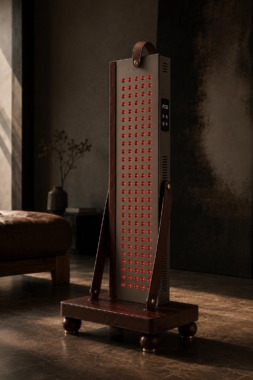
The Celsium Studio red light therapy panel is designed for larger-area home and professional wellness use. Its technical platform includes 720 dual-chip LEDs, adjustable wavelength channels, dimming, pulse control, touchscreen operation, remote control, Bluetooth and app connectivity. It is compatible with 100–240 V electrical systems.

The compact Celsium Core red light therapy panel is intended for more targeted or space-conscious use while maintaining configurable light-therapy functions.

The key distinction is not that one wavelength is “stronger” because the panel is larger. Panel size, LED count, coverage area, irradiance at a stated distance and treatment goal should all be considered together.

Explore all available systems in the Celsium red light therapy collection.

How to Use a Multi-Wavelength Panel Responsibly

Always prioritise the product manual. General articles cannot determine the correct dose for an individual device and user.

Practical principles include:

  • Choose one clearly defined goal rather than activating every function automatically.
  • Use the recommended distance and start with the manufacturer’s conservative session settings.
  • Avoid increasing intensity and treatment time at the same time.
  • Track the wavelengths, distance, intensity and session duration used.
  • Allow consistency over time before evaluating the routine.
  • Stop if the skin becomes persistently irritated, painful or unusually sensitive.
  • Follow the supplied eye-protection instructions, especially with bright visible channels.


Do not use the panel to diagnose or treat a medical condition without professional guidance.

Safety and Who Should Seek Medical Advice

Red and near-infrared light are non-ionising, which means they do not carry the same ionising radiation risks as X-rays. That does not make every dose or application appropriate for every person.

Seek medical advice before use if you:

  • take medication that increases photosensitivity;
  • have a diagnosed light-sensitive disorder;
  • are receiving treatment for cancer or have a suspicious lesion in the treatment area;
  • have an active eye condition;
  • are pregnant and plan to expose the abdomen;
  • have an implanted electronic device and are unsure about compatibility;
  • intend to use the panel for a diagnosed medical condition.


Never direct intense light into the eyes or assume that closing the eyelids provides adequate protection. Follow the panel’s supplied eye-safety instructions.

What the Research Does Not Yet Prove

The popularity of light therapy has grown faster than the evidence for some commercial claims. Current research does not prove that:

  • nine wavelengths are always better than two;
  • one universal protocol works for every user;
  • higher irradiance always produces better results;
  • consumer panels cure chronic disease;
  • all studies using lasers apply equally to LEDs;
  • findings from cells or animals guarantee human outcomes;
  • a wavelength alone determines the result without considering dose.


High-quality product information should explain limitations as clearly as potential applications. This protects users and makes the technology easier to evaluate honestly.

Frequently Asked Questions

Is a nine-wavelength panel better than a two-wavelength panel?

It is more configurable, but not automatically more effective. A nine-wavelength panel provides broader spectral coverage and more protocol options. Results still depend on dose, distance, treatment time and consistency.

Are all nine wavelengths red light?

No. The 480 nm channel is blue, 590 nm is amber, 630–670 nm are visible red, and 810–1060 nm are near-infrared. “Red light therapy” is often used as a broad consumer term, but multi-spectrum light therapy is more technically accurate.

Can I see the near-infrared LEDs working?

Near-infrared light is outside normal human vision. Some LEDs may show a faint visible glow, but brightness is not a reliable measure of NIR output.

Should all wavelengths be used simultaneously?

Not necessarily. The correct combination depends on the intended routine and the manufacturer’s protocol. More active channels also change the total delivered energy.

What is the difference between 660 and 850 nm?

660 nm is visible red light and is commonly selected for skin-facing and relatively superficial targets. 850 nm is invisible NIR and is generally used when broader or deeper tissue exposure is intended. Their effects overlap and remain dose-dependent.

Does 1060 nm penetrate the deepest?

Longer wavelength does not create a simple “deeper is always better” scale. Tissue absorption and scattering change across the spectrum. Claims about 1060 nm must be based on the actual device and protocol.

How quickly should I expect results?

There is no universal timeline. Research protocols vary from single-session measurements to repeated use over several weeks. The outcome, dose, device and individual all influence the response.

Can red light therapy replace medical treatment?

No. A wellness panel should not replace diagnosis, prescribed medication, rehabilitation or other professional care.

Final Perspective

The value of a nine-wavelength system is control. Blue, amber, red and near-infrared channels allow one platform to cover a wider spectrum than a conventional red-and-NIR panel.

That flexibility should be paired with precision. The wavelength must be considered alongside irradiance, distance, treatment time and total dose. Scientific studies should inform expectations, not be converted into guaranteed marketing promises.

Celsium’s 480, 590, 630, 660, 670, 810, 830, 850 and 1060 nm system is designed to make multi-spectrum light therapy configurable for modern home and professional wellness spaces. Used responsibly, it provides a platform for structured routines ranging from visible-light skin applications to red and near-infrared body-focused sessions.

Explore the Celsium Studio panel, discover the compact Celsium Core panel, or read more about the broader benefits and limitations of red light therapy.

Dive Into The Blog

Subscribe to our newsletter

Be the first to hear about new saunas, wellness tips,

and exclusive offers.

Subscription Form
ContactForm

Choose Your Region

To ensure accurate pricing and delivery details, please confirm your location.

Continue

You can update this anytime from the menu.